
If you've ever looked at a piece of sheet music and seen a row of strange # and ♭ symbols right after the treble clef, that's a key signature. It's a small set of symbols, but it tells you a huge amount about the music that follows.
Learning to read a key signature is one of those moments where a piece of music suddenly stops being cryptic. Once you know what those symbols mean, you can instantly see which key a song is in — and that's useful whether you're a musician, a producer, or a DJ.
Key takeaway
A key signature is the group of sharps or flats written at the start of a staff. It tells you which notes are raised or lowered for the whole piece — and which key (or its relative minor) the music is in.
What Is a Key Signature in Music?
A key signature is the set of sharps (♯) or flats (♭) placed at the beginning of a line of music, after the clef.
It exists so that composers don't have to write a sharp or flat next to every single note. If a song is in A Major — which has three sharps (F♯, C♯, G♯) — the key signature shows those three sharps once, at the start. Every F, C, and G in the piece is then played as F♯, C♯, and G♯ automatically.
Put simply: the key signature is a shortcut that tells every note on the page "these are always sharp or flat in this piece."
Why do musicians care? Because the key signature instantly reveals the key — the tonal center of the music. Two pieces in the same key share the same key signature, which tells you immediately about their harmony. To see how that key expands into an actual set of notes, read our guide to major and minor scales.
How Sharps and Flats Work
Sharps and flats are the only two kinds of accidentals you'll find in a key signature:
- A sharp (♯) raises a note by one semitone.
- A flat (♭) lowers a note by one semitone.
Some keys use only sharps, some only flats, and some use neither. The C Major key signature has no sharps or flats at all — it's the "clean" starting point.
Here's the actual key signature for A Major (3 sharps):

Here's Ab Major (4 flats) — note how flats sit on different lines than sharps:

Key takeaway
The sharps and flats in a key signature always appear in the same order. Sharps go F♯, C♯, G♯, D♯, A♯, E♯, B♯; flats go B♭, E♭, A♭, D♭, G♭, C♭, F♭.
How Many Sharps or Flats Does Each Key Have?
Here's a quick reference for the most common major keys and their key signatures:
| Key | Key Signature |
|---|---|
| C Major | No sharps or flats |
| G Major | 1 sharp (F♯) |
| D Major | 2 sharps (F♯, C♯) |
| A Major | 3 sharps (F♯, C♯, G♯) |
| E Major | 4 sharps (F♯, C♯, G♯, D♯) |
| B Major | 5 sharps (F♯, C♯, G♯, D♯, A♯) |
| F Major | 1 flat (B♭) |
| B♭ Major | 2 flats (B♭, E♭) |
| E♭ Major | 3 flats (B♭, E♭, A♭) |
| A♭ Major | 4 flats (B♭, E♭, A♭, D♭) |
There's a musical reason behind the order, but for everyday use you mostly just need to remember the count and which notes are affected.
How to Read a Key Signature
Reading a key signature is simple once you know what to look for:
- Look at the clef — the key signature follows it.
- Note the sharps or flats — count them and check their order.
- Figure out the key — the position of the last sharp, or a well-known flat position, tells you the major key.

For sharp keys, the major key is a half step above the last sharp. For example, the last sharp in A Major is G♯; a half step up is A — so it's A Major.
For flat keys, the major key is a fourth below the last flat (or the second-to-last flat names the key). The last flat in A♭ Major is D♭; going down a fourth gives you A♭ — so it's A♭ Major.
What About Relative Minors?
Every major key has a relative minor that shares the same key signature.
For example, A Major and F♯ Minor both have three sharps. The music looks similar on the page — same key signature — but the tonal center is different. F♯ feels like "home," not A.
This is exactly how DJs and producers use the Camelot Wheel: the relative major/minor pair (the same "number", different letter) shares a key signature, so they mix smoothly.
If all of this circles back to the same relationships, that's because the Camelot Wheel and the circle of fifths are essentially the same diagram — the same twelve keys arranged around a circle, just called by different names. The circle of fifths uses classical names (C, G, D, A…), while the Camelot system labels them with numbers and letters (8B, 9B, 10B, 11A…).
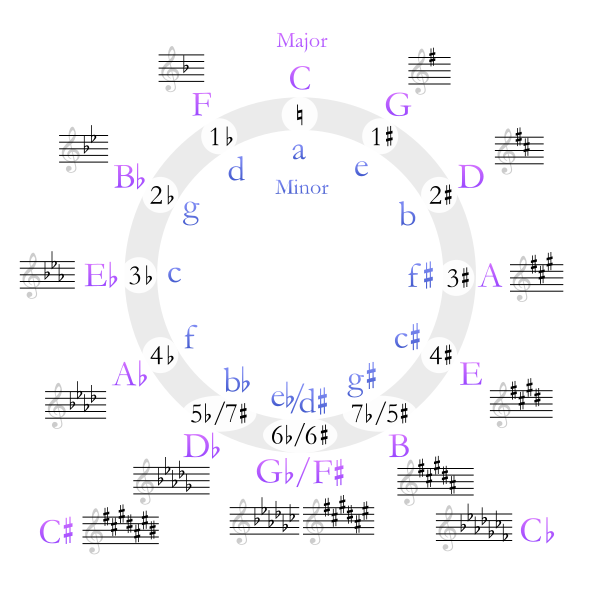
That's exactly why Song Key Finder shows results in two modes: a Music Theory mode with the classical key signatures and piano, and a DJ mode built on the Camelot Wheel for harmonic mixing. Same keys, two vocabularies — whichever you're more comfortable with, the relationships underneath are identical. You can try the interactive Camelot Wheel here to see the matching numbers and letters in action.
Use a Key Detector So You Don't Have to Memorize Everything
You don't have to memorize every key signature (though the table above helps). A key detector or key checker can tell you the key and key signature of any song instantly — from a file or from YouTube, Spotify, or other streaming platforms.
That frees you up to spend your energy on the fun part: deciding whether two songs actually sound good together.
Key Signatures for DJs and Producers
If you're a DJ or producer, key signatures matter more than you might think. Knowing the key signature of a track helps you:
- Pick compatible keys for smooth harmonic mixing
- Avoid dissonant combinations that sound wrong
- Identify relative minors so you can shift mood during a transition
A key finder shows you both the key and its signature in seconds — so you spend less time on theory and more time making good musical decisions.
Related: Music Theory for DJs · What Is the Camelot Wheel?
Photos: Mike Castro Demaria, Dolo Iglesias (Unsplash) · Circle of fifths diagram: Just plain Bill